From Content to Workflow: Four Capabilities Defining The Future of AI-Native Courseware

What Replaces Higher Education Courseware After AI: The Emerging Shape of The Market for AI-Native Courseware
In a recent blog, The Collapse of US Higher Education Courseware, I argued that the current generation of market-leading courseware products are entering a period of structural decline. Student use of generative AI, accelerated by institutional enablement, has undermined the fundamental teaching and learning models that current courseware was engineered to support. (This is the next stage of the market evolution I first projected in 2023.)
As this category breaks, demand for teaching and learning tools won’t disappear—it will re-form. In this post, I map the emerging instructional and institutional needs that are already visible across higher education—and that I believe will define the market for future AI-native courseware. (These shifts are already visible across higher education—EDUCAUSE’s 2025 Horizon Report describes AI as reshaping how students engage with content and how learning itself is documented and valued.)
What follows is not a speculative gaze into an AI crystal ball. Instead, I’ve found the most reliable way to identify major market opportunities is to return to first principles: understand how your customers’ fundamental “jobs to be done” are changing. Those changing jobs—not technology trends—define the markets that will emerge next.
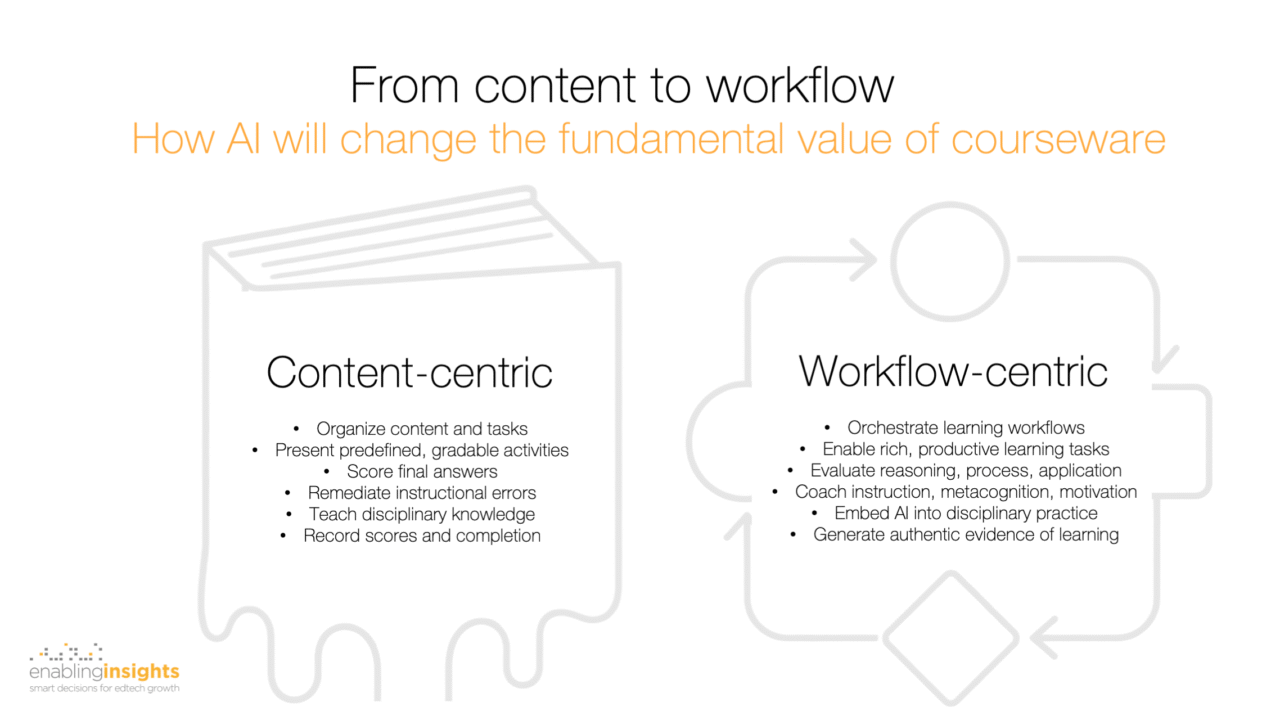
There is one foundational shift that underpins everything discussed in this article. Today’s market-leading courseware has been architected around content—presenting instructional material, assigning tasks, scoring answers, and recording grades. The next generation of courseware will instead be architected around learning workflows: orchestrating how students, instructors, AI systems, assessment, and coaching interact throughout the learning process. The four emerging needs below are all manifestations of that deeper architectural shift.
Through that lens, here are what I see as the four most substantial needs and practices that are emerging.
Need 1: AI-Enriched Learning Tasks—From Answers to Productive Work
For more than 25 years, digital courseware in higher education has evolved by expanding the range of tasks it could automatically score: from multiple-choice to numerical problems, to symbolic algebra, to writing and graphing. These advances were not driven by technology for its own sake; they responded to instructors’ desire for more authentic, productive student work that could still scale.
That ambition is supported by a remarkably consistent body of research spanning more than two decades. The National Research Council’s seminal How People Learn (2000), Chi and Wylie’s highly cited ICAP framework (2014), the National Academies’ updated How People Learn II (2018), and more recent research on assessment and learning in the GenAI era (Xia et al., 2024) all reinforce the value of moving beyond answers and recall towards constructive, applied learning that develops and demonstrates understanding.
Generative AI does not invalidate this research, but it does reshape which learning tasks are valuable for students and which assessment signals are useful to instructors. When AI can instantly produce an answer, the answer itself becomes a weak proxy for learning. What remains valuable are tasks that require students to frame problems, apply judgment, interpret results, justify decisions, and reflect on trade-offs.
AI now makes it economically viable to assess these kinds of productive tasks at scale:
- multi-step reasoning and explanation
- critique and refinement of AI outputs
- virtual experiments and simulations
- multimodal work combining text, code, data, diagrams, and speech
This is not “AI scoring” as a gimmick. It is the long-standing instructional goal of productive work, finally made scalable. The next generation of AI-native courseware will no longer exist primarily to organize content and collect answers. It will orchestrate productive learning workflows that generate richer evidence of learning while supporting the kinds of authentic tasks instructors have always wanted to teach.
Need 2: Feedback, Remediation, and Coaching—Beyond a Single Swim Lane
Courseware has always promised feedback, remediation, and adaptivity. In practice, it has struggled to deliver these at depth.
The research is clear: feedback matters. Meta-analyses by Hattie and others show strong effects when feedback is timely, specific, and connected to task goals. Work on self-regulated learning (Zimmerman) and motivation (Dweck, Yeager) demonstrates that metacognitive and motivational support are as important as instructional correction—especially in higher education.
Yet most courseware has focused on a single swim lane: instructional remediation tied to specific errors. Deeper adaptivity proved brittle and expensive to author, difficult to maintain, and hard to productize at scale. This is where agentic AI changes the equation.
Rather than hard-coding adaptive pathways, AI systems can dynamically draw on existing, evidence-based strategies for instruction, metacognition, and motivation—strategies that already exist in the literature and in institutional practice. They can interpret student behavior in context and decide whether to:
- clarify a misconception
- prompt reflection
- encourage strategy change
- provide a motivational nudge
Crucially, these systems can be evaluated and optimized against outcomes institutions care about—persistence, completion, mastery—rather than simply correctness. This does not replace instructional design; it makes it deployable at scale.
The emerging need is not “more adaptivity.” It is integrated coaching, grounded in learning science, and responsive to how students actually learn with AI. Rather than treating feedback as a single instructional event, future AI-native courseware will orchestrate continuous coaching workflows that combine instruction, metacognition, and motivation throughout the learning process.
Need 3: AI Literacy Is Discipline-Specific—Not Generic
As I highlighted in my Faculty–OpenAI presentation to higher education leaders, A roadmap for AI in higher education, AI is not just changing tools—it is rewriting jobs. Across industries, we see consistent patterns:
- Software Engineering is shifting from writing code to reviewing, testing, and improving AI-generated code.
- Marketing and Business increasingly rely on AI to build personas, run experiments, and optimize campaigns.
- Medicine is adopting AI for summarization, pattern recognition, and diagnostic support—with human judgment central.
- Law is using AI for research, precedent scanning, and drafting, while accountability remains human.
Employers are no longer asking whether graduates “know about AI.” They are asking whether graduates can use AI competently within professional workflows. Higher education is responding (EDUCAUSE’s AI Literacy in Teaching and Learning already defines general competencies). Departments are beginning to redesign courses so students practice:
- prompting and verification
- critique of AI output
- integration of AI into disciplinary reasoning
- ethical and contextual judgement
This is evolving into two expectations for students’ learning in higher education:
- General AI literacies—transferable skills like verification, bias detection, and iteration.
- Discipline-specific AI practice—how AI is actually used in a given discipline or profession.
Future AI-native courseware must support both. Generic AI literacy tools are insufficient. What institutions need are course-level systems that embed AI use directly into disciplinary learning, and make that use visible and assessable over time.
Need 4: Assessment After the Task Model—Restoring Legitimacy
The auto-graded item was the defining innovation of digital courseware. It enabled scale, consistency, and efficiency. However, it’s now quickly becoming obsolete.
When AI can generate the answer, the reasoning, and the explanation instantly, scores no longer signal learning. Institutions know this, which is why we are seeing early moves toward:
- authentic performance tasks
- “show your thinking” expectations
- multimodal reasoning
- AI-inclusive assessment where students critique or refine AI outputs
This shift is grounded in long-standing assessment theory. Authentic assessment, assessment for learning, and alignment between formative and summative assessment are not new ideas. What is new is the urgency with which institutions must act.
Temporary retreats to AI-free environments may preserve yesterday’s assessment in the short term, but they are neither scalable nor educationally desirable. Instead, institutions are beginning to require reciprocal transparency: clear norms for AI use, disclosure expectations (for instructors as well as students), and evidence of student contribution. Recent EDUCAUSE research confirms that this shift is well underway, with faculty evolving assessment design and expectations around appropriate AI use.
Next-generation courseware must align with these emerging institutional frameworks. It cannot operate around them.
More fundamentally, assessment itself becomes part of a broader learning workflow rather than simply the end of one. Instead of merely recording whether students arrived at the correct answer, courseware will increasingly orchestrate how students frame problems, use AI appropriately, justify decisions, reflect on outcomes, and demonstrate growing competence over time.
The emerging need is for AI-supported assessment that embraces AI use while restoring trust in learning signals—not through surveillance, but through design.
From Collapse to Opportunity
The collapse of current courseware is not a failure of digital learning. It is the predictable result of tools built for a pre-AI world colliding with AI-enabled teaching, learning, and assessment.
What replaces it will not be defined by larger task banks or smarter auto-grading. It will be defined by four capabilities:
- AI-enriched, productive learning tasks
- Integrated instructional, metacognitive, and motivational support
- Discipline-shaped AI literacies embedded in coursework
- Assessment designs that restore legitimacy in an AI-rich environment
For publishers, AI-enhanced versions of legacy courseware will not close the gap. The strategic question is whether they are prepared to shift their value proposition from delivering content to orchestrating learning workflows. (That product transformation sits alongside an equally fundamental opportunity to redesign publishers’ operating models around AI-enabled workflows.)
For startups, this represents a rare market category reset.
For investors, the signals are still early—but very consistent.
The winners will not simply incorporate AI into existing products. They will build platforms that enable richer teaching, learning, and assessment by orchestrating AI-enabled learning workflows from first principles.
Want an independent challenge to your strategy?
If you’re a publisher, I’d be delighted to help you assess how far your current strategy and product roadmap can evolve—and where a more fundamental architectural shift may be required. I regularly advise CEOs, Chief Product Officers, and leadership teams on AI strategy, product reinvention, and long-term portfolio direction.
If you’re an edtech founder, I can help you identify genuine market white space, pressure-test your product strategy, and design products around the emerging needs of institutions and instructors—not today’s technology trends.
If you’re an investor, I can help you distinguish between businesses that are simply adding AI to existing products and those genuinely positioned to lead the emerging market for future AI-native courseware.
The coming decade will reward organizations that recognize this architectural shift early, place bold but disciplined strategic bets, and build deliberately for where higher education is heading—not where it has been.