
The 40% Shift: Why Educational Publishing Must Redesign Its Operating Model
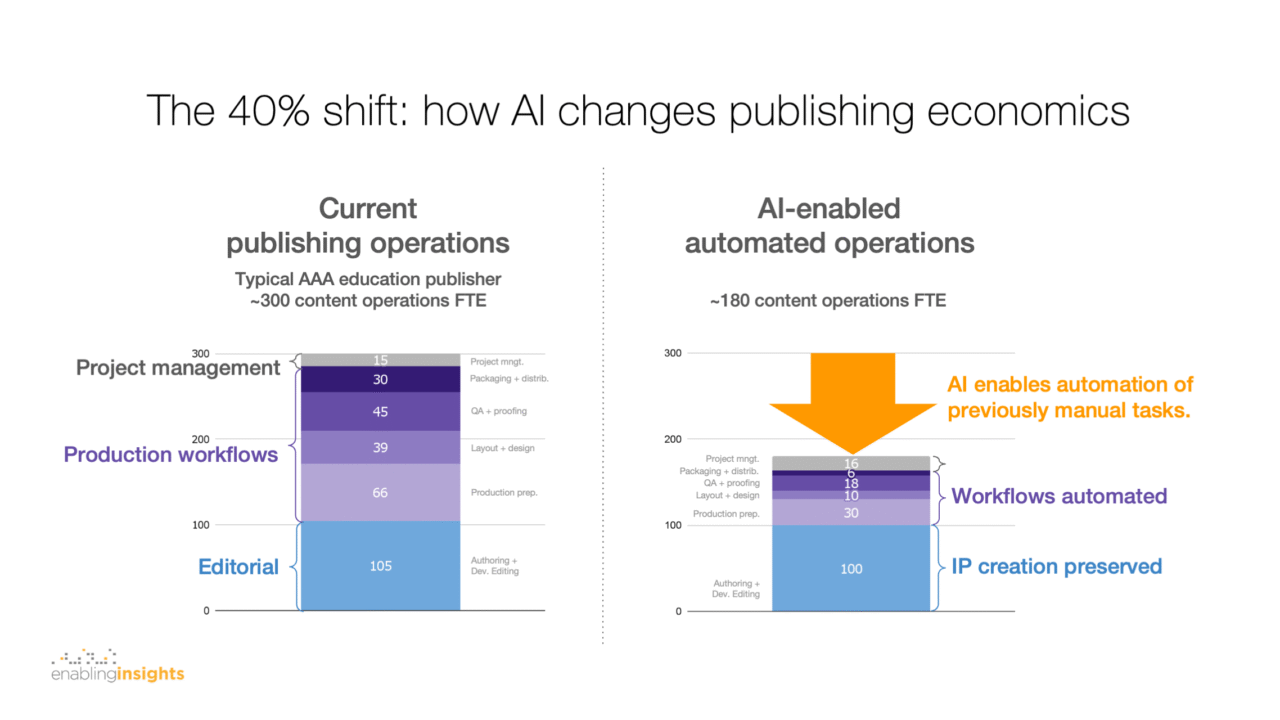

Why AI publishing operations are becoming a strategic priority
Educational publishing has spent years digitizing products while largely preserving a print-era operating model.
Most educational publishers now spend more on production operations than on creating intellectual property. Not on authorship, pedagogy, or differentiated learning design, but on the surrounding workflows: production preparation, layout and formatting, QA and proofing, packaging and distribution, metadata management, localization, and coordination.
This operating model evolved over decades as publishers moved from print books to print + digital to print + digital + courseware. At each stage, more formats, product variants, updates, integrations, accessibility requirements, localization, and operational coordination. With each wave of complexity, publishers have added process, staffing, vendors, oversight, and tooling.
To contain this growing operational overhead, I witness publishers pursuing:
- cost reduction programmes
- outsourcing
- workflow efficiencies
- portfolio rationalization (cut the long tail)
- and incremental technology upgrades.
These approaches have helped manage the problem temporarily, but they have not fundamentally improved the underlying economics of the operating model itself.
AI now changes the equation because, for the first time, it makes significant parts of this operating model reliably automatable—creating a path toward structurally lower cost and greater operational agility. (I explored the case for agents as a step-change opportunity for efficiency in How AI agents can transform the profitability of educational publishing.)
Publishing’s hidden cost structure
Most publishers understand their editorial costs, product investment priorities, and vendor spend very well. But fewer have explicitly mapped where operational labour and complexity actually concentrate across their publishing lifecycle.
Over the past several months, I have been working with Gutenberg Technology to analyse the operational structure of educational publishing workflows. The goal was not to produce a precise benchmark for every publisher. The industry is too varied for that. Product mixes differ. Vendor dependency differs. Some organizations are heavily print-oriented, while others are substantially more digital. Some internalize production work; others distribute it across freelancers, XML houses, localization partners, and external production vendors.
Instead, we wanted to understand the shape of the operating model itself: where operational effort accumulates, which workflows require the greatest coordination overhead, and which parts of publishing operations are structurally amenable to orchestration and automation.
Across many organizations, a remarkably consistent pattern emerged.
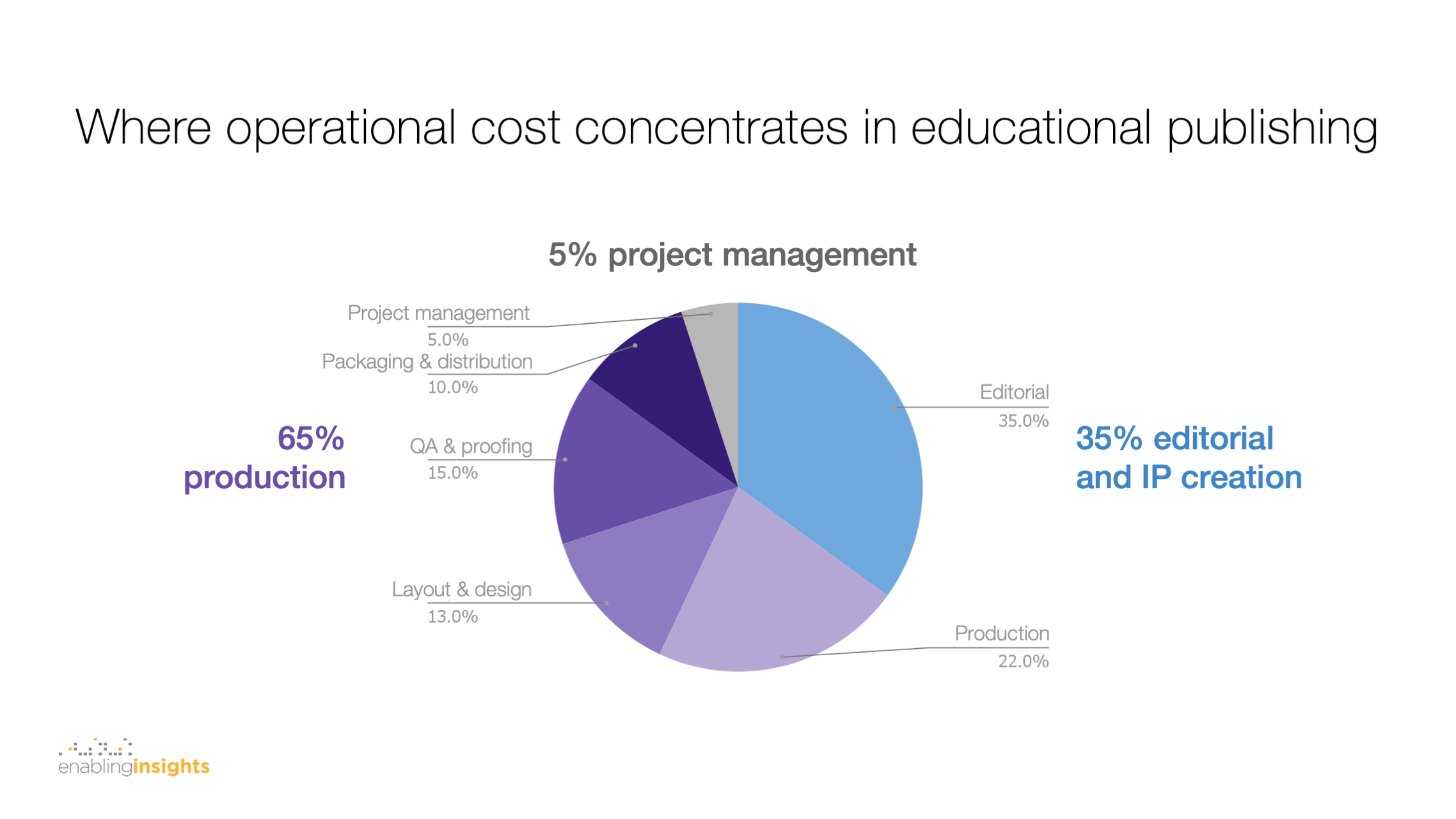
A substantial proportion of operational effort sits in production workflows rather than in editorial and IP creation. The exact percentages vary by publisher, but the directional pattern remains very consistent.
Production preparation, layout and formatting, QA and proofing, packaging and distribution, metadata management, localization, and the coordination layers surrounding them collectively make up a very large share of operational labour.
That balance is important because editorial and IP creation are where publishers create differentiated value. By contrast, production operations are where publishers accumulate cost and complexity.
AI could push the current model to breaking point
Historically, that structure made sense. The economics of publishing were built around the constraints of print production. But over time, as publishers’ print/digital portfolios have become more complex, many have accumulated operational overhead faster than they have grown value creation.
Those pressures were already difficult to manage. AI now amplifies them simultaneously:
- Margin compression
Slowing growth, pricing pressure, and rising production costs - AI disruption of courseware
Students compromising assessment using AI tools (for more details, see my assessment The collapse of US higher education courseware: 2025 strategic analysis) - Dual investment burden
Building AI-native experiences while maintaining existing products - Rising operational complexity
More variants, formats, updates, and localization requirements
Any one of these challenges is manageable. But all four create something different: a structural operating-model problem rather than a conventional productivity issue. (See HolonIQ’s excellent forecast of global education market changes in The Global Eduaction Outlook, 2025 edition.)
This is not a efficiency issue
Most publishers have tackled these challenges as an efficiency issue. As a result, they have focused on improving workflows, optimizing tooling, reducing cycle times, or increasing staff throughput. Those initiatives tend to deliver incremental gains.
Why? Because if you treat this as a efficiency issue, you incrementally optimize today’s workflows. By contrast, if you treat this as a structural issue, you redesign workflows for tomorrow—and ultimately the operating model.
This changes the strategic question from “How do we work faster?” to “How should publishing operations work in an AI-enabled environment?”
This is where AI changes the equation. It does not simply improve the economics of the current operating model. It enables a fundamentally different model whose economics can be materially better.
Why AI changes the equation
The critical insight is that many production workflows in education publishing are exactly the type of operational work that AI systems are increasingly good at automating because they are:
- repetitive
- rules-based
- highly structured
- coordination-heavy
- and governed by standards, templates, metadata rules, accessibility requirements, and validation criteria.
This is not primarily about automating authorship, pedagogy, conceptual editorial thinking, or high-value learning design. It is about automating governed operational execution.
Most publishers already possess enormous amounts of operational intelligence: style guides, metadata structures, QA rules, accessibility standards, workflow definitions, and packaging conventions. The challenge is that this knowledge is often fragmented, inconsistently documented, or embedded in disconnected systems and manual workflows.
In many ways, automation is simply the process of turning operational knowledge that already exists inside publishers into systems capable of executing it consistently and at scale.
This is also why we’re entering a new era. The workflows themselves are not entirely new. What has changed is the capability of AI systems to reliably automate publishing operations that historically required large amounts of manual coordination. Arguably, this transition was not economically viable even two years ago. (See McKinsey’s excellent analysis, The economic potential fo generative AI: the next productivity frontier.)
But AI agents today bring it within reach. (See my analysis of why to pivot to agents and how to deploy them successfuly in Stop building AI features and start onboarding AI agents.)
The 40% Shift
So what does the economic case for structural redesign actually look like?
To explore that question, we modelled the operational structure of a large educational publisher with roughly 300 people involved in content operations.
Importantly, this is not a forecast and should not be interpreted as an industry benchmark. The exact numbers vary significantly by publisher structure, product mix, workflow maturity, localization requirements, vendor dependency, and operational sophistication.
The purpose of the model is directional rather than predictive.
We analysed where labour and coordination costs sit, how workflows are structured, where repetitive operational execution concentrates, how much rework exists in the system, and how much operational effort could plausibly be reduced through workflow redesign, orchestration, and automation.
What emerged is not a picture of marginal efficiency gains, but the opportunity for structural transformation.
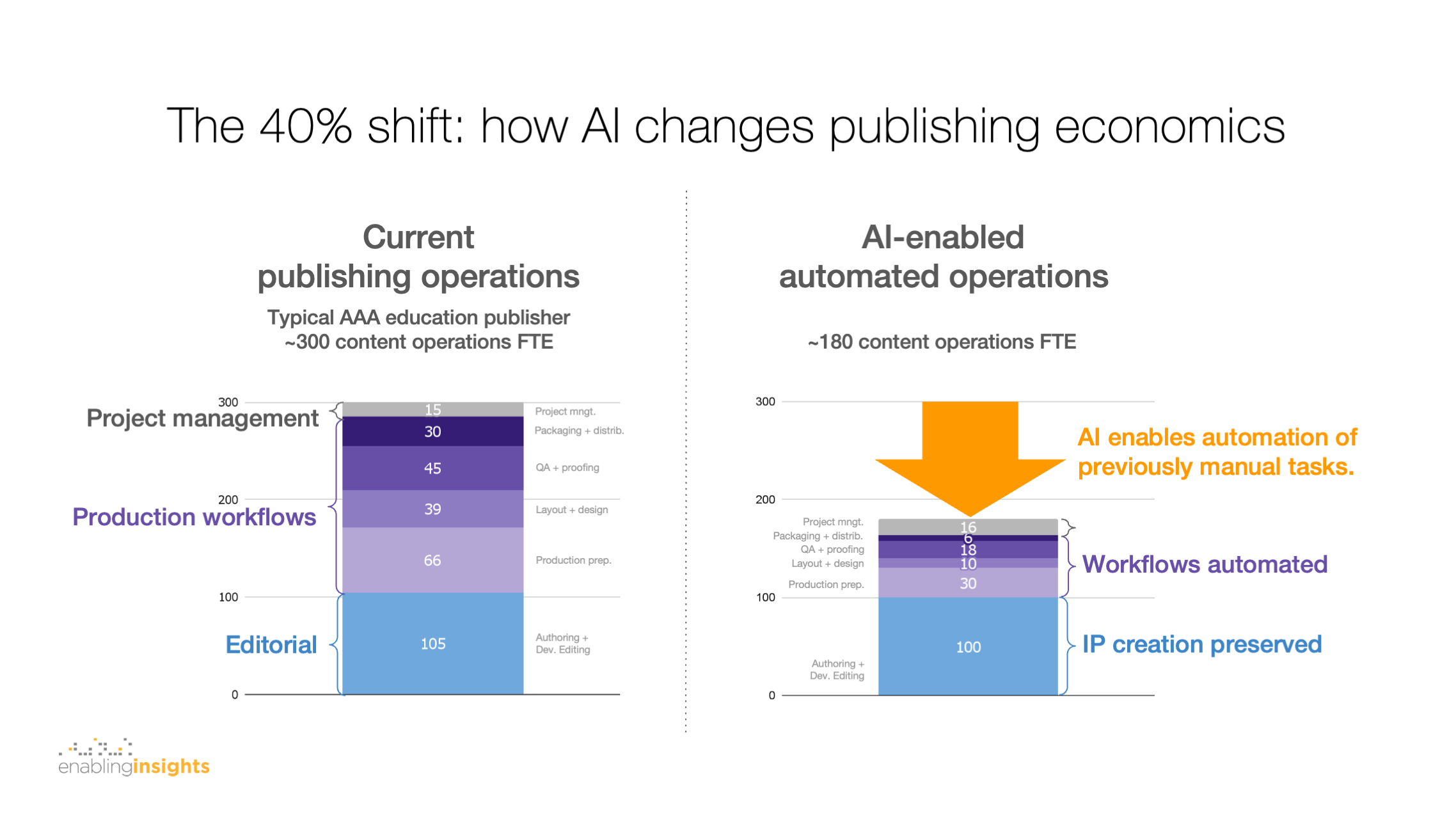
Directionally, the model suggests that large publishers could potentially reduce operational effort by approximately 30–50% over time—not through a single breakthrough, but through the cumulative effect of:
- redesigning workflows around structured content
- reducing manual coordination and handoffs
- eliminating repetitive rework cycles
- orchestrating production workflows systemically, and
- progressively automating governed operational tasks.
In practice, that also reduces dependence on labour-intensive production processes and fragmented vendor coordination.
In large organisations, that can translate into materially lower operational overhead, lower vendor dependence, faster release cycles, improved reuse across formats and products, and significantly greater operational agility.
The exact percentages matter less than the shape of the economics.
The key point is that AI can now make the operational economics of educational publishing structurally redesignable.
This is not simply about cost reduction. It is about building publishing organizations that are more efficient, more economically resilient, more adaptable, and better able to respond to tomorrow’s market needs in an AI era.
The mistake many publishers are making
Most publishers are experimenting vigorously with AI, primarily by focusing on efficiency gains in narrow tasks within existing workflows. Despite all this activity, I have not yet spoken to a publishing executive who has said those innovations are heading toward material improvements in their economics.
The reason is that the largest economic gains do not sit in isolated tasks. They sit in workflows, coordination, rework, and operational complexity. And tackling those requires a system-level change, starting with getting the foundations right.
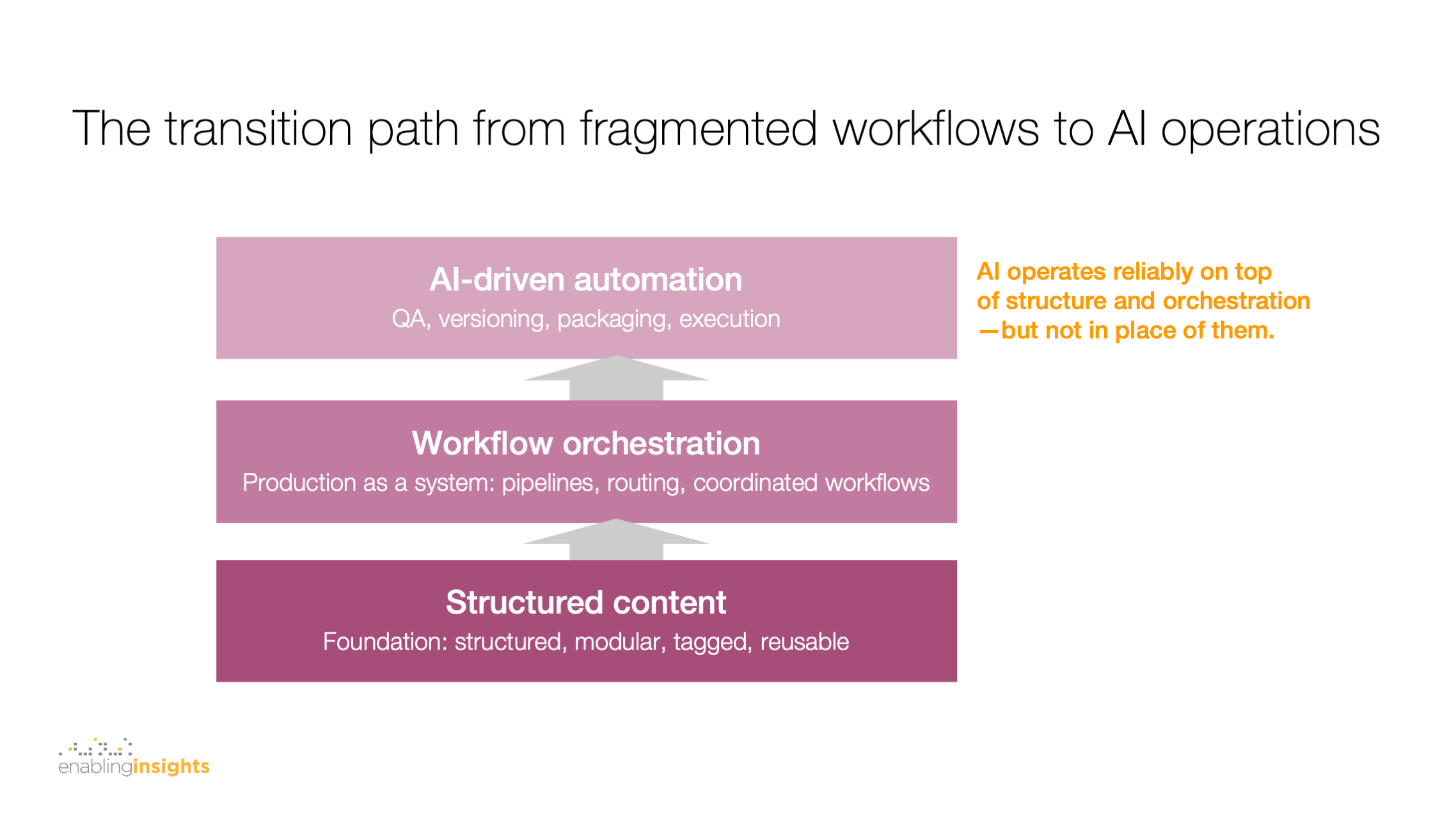
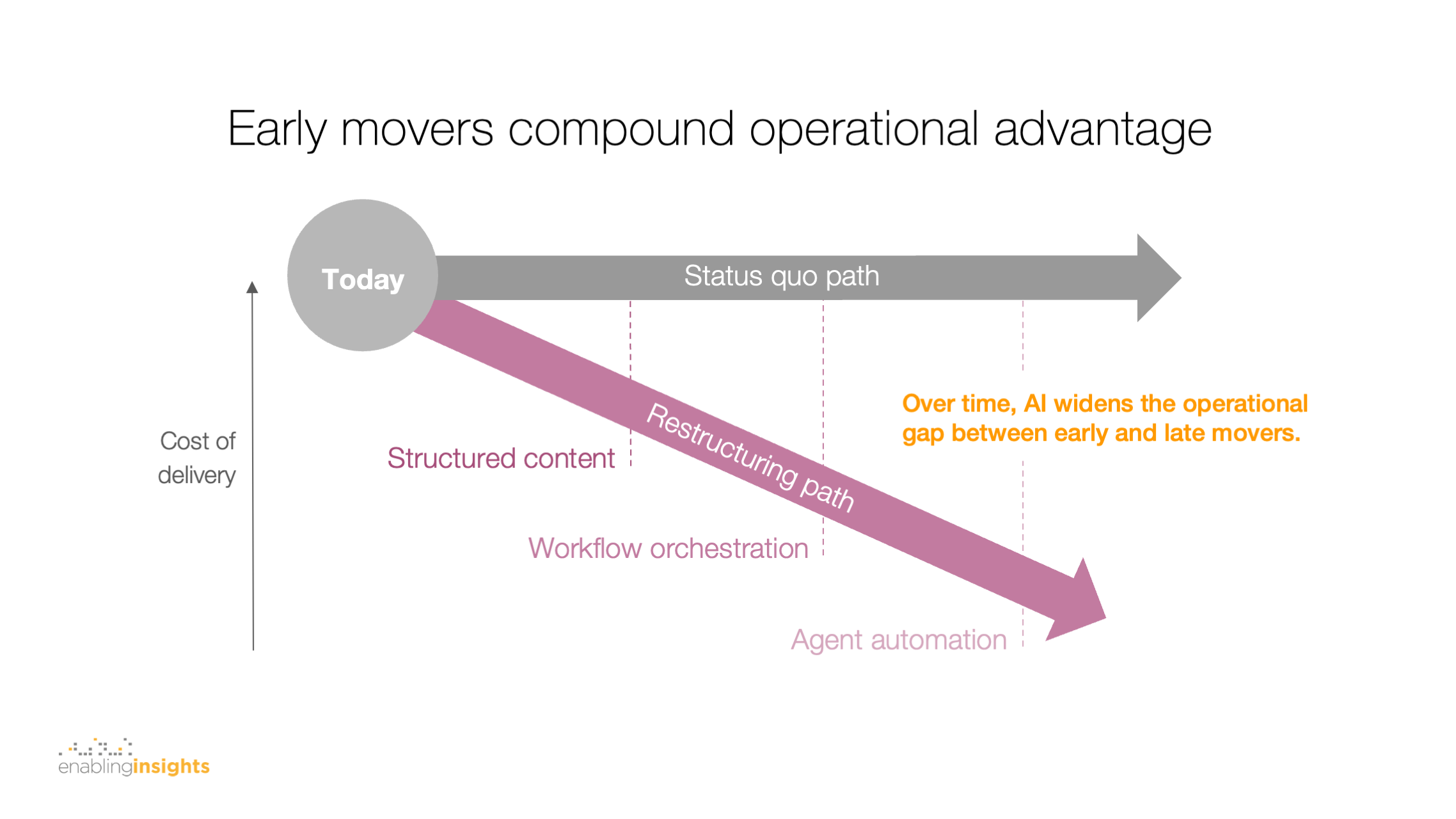
First, you need structured content. Content has to exist as something an AI system can reason about. It needs to be structured, modular, consistently tagged. Most publishers currently have assets locked in diverse legacy documents or layouts.
Second, you need workflow orchestration. For this, production has to operate as a system. Namely, with defined pipelines, task routing, and coordinated workflows. Most publishers’ workflows include multiple manual handoffs between file formats, emails, and teams.
Once content is structured, and workflows are orchestrated, then you can deploy reliable and effective automation to the QA, versioning, packaging, and increasingly, production execution itself.
This is why many AI pilots struggle. Most organizations attempt to apply AI to workflows that were never designed to be automated in the first place. Without structure and orchestration, AI improves isolated tasks but does not fundamentally change the operating model.
You cannot reliably orchestrate content that is not structured and consistently tagged. And you cannot reliably automate workflows that are not clearly defined and repeatable.
The compounding advantage of early movers
This is not a static transition.
Publishers that begin restructuring now will reduce operational overhead earlier, simplify workflow complexity, accelerate release cycles, improve content reuse, reduce coordination costs, and become both more adaptable and more economically resilient over time.
Those that delay will accumulate operational debt, workflow fragmentation, growing retrofit complexity, and increasing coordination overhead—all of which become progressively harder and more expensive to unwind later.
The organizations most likely to emerge stronger are unlikely to be the publishers with the most innovative AI features. They are more likely to be the publishers with the most efficient, scalable, and adaptable operating model—one designed to respond effectively to changing market demands rather than carry the accumulated overhead of previous generations of publishing infrastructure.
Closing
Educational publishing has been carrying increasing operational overhead for years. As the industry evolved from print books to digital products and then to increasingly sophisticated courseware, the operating model accumulated complexity, staffing, coordination, vendor dependence, and cost. Most responses so far have been defensive: cost reduction, outsourcing, portfolio simplification, and incremental workflow optimization.
AI is now placing even greater strain on that model as it simultaneously erodes parts of the value proposition of current products. But it also makes reinvention of the operating model economically viable.
The question now is not whether educational publishing changes, but which organizations redesign early enough to benefit from it—building operating models that are structurally more efficient, more adaptable, and better aligned with where publishers actually create value today, and will in the future.
If you are navigating how AI changes the economics, workflows, and operations of your educational publishing business, and want a confidential, strategic, and grounded perspective on how to respond, please reach out—I would be delighted to help. I regularly advise CEOs, operational leaders, and investors on AI transformation, operating-model redesign, and the future of educational publishing.