
The Collapse of US Higher Education Courseware: 2025 Strategic Analysis
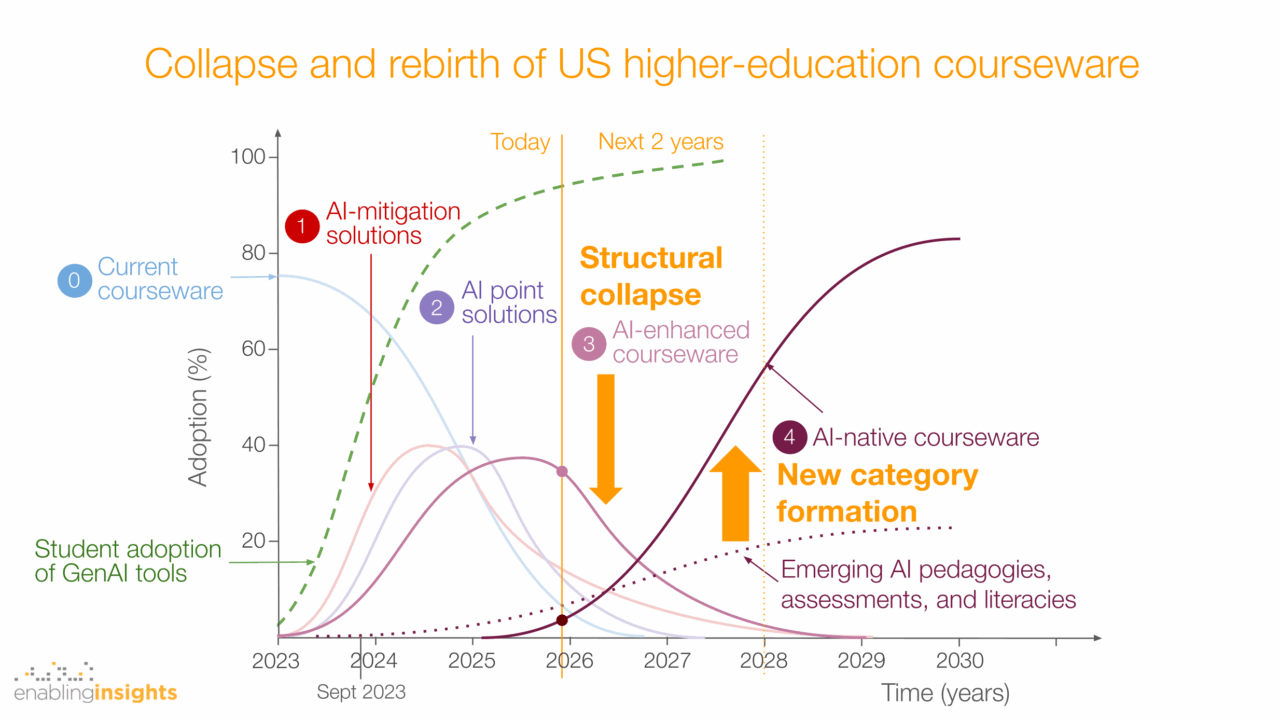

Two years ago I projected the collapse of US higher education courseware
Two years ago, I argued that the US higher education courseware market—worth ~$3B annually and largely unchanged for nearly 20 years—would fall into decline because of AI. That shift is now underway, and the early signs of the collapse of US higher education courseware are increasingly visible.
In September 2023, I developed the strategic schematic above (see Which AI edtech will win, when, and why) to project that, as GenAI tools became available to students, the market would see the rise and fall of AI-mitigation tools and AI point solutions; that existing courseware would become AI-enhanced without changing its underlying learning or assessment model; and that emerging pedagogies would ultimately create the conditions for AI-native courseware built for a new era of teaching and learning.
My aim wasn’t to claim superior foresight. It was to demonstrate that, even in the noisy, hype-driven world of edtech, it is possible to anticipate strategic market changes by tracking technology trajectories, emerging instructor practices, and institutional incentives—rather than looking in the rear-view mirror at competing products.
What none of us could see then was which AI capabilities would emerge, or how quickly. Now we can—and these capabilities are reshaping higher education more profoundly and rapidly than in any other period in recent history.
1. The Market Trajectory Is Now Clear
Looking back, the projections I made in 2023 have largely played out:
Track 1. AI-mitigation tools have proliferated—and waned.
Dozens of tools promised to detect or prevent student use of AI. Most proved unreliable, difficult to scale, or fundamentally misaligned with the realities of a changing world. They also undermined the trust between learners and instructors—an essential contract for learning.
Track 2. AI point solutions have exploded—but none have succeeded at scale.
These tools use AI to solve modest needs in novel ways (e.g., generating activities, synthesizing insights, or scheduling interventions), but they have not supported enough of instructors’ core workflows to meaningfully compete with incumbents or reshape teaching practice.
Track 3. Market-leading courseware has been retrofitted with AI—but not transformed.
Nearly all incumbents now include “AI tutors” or “AI assistants.” But these are in-margin bolt-ons that create short-term marketing fizz, but (consciously) don’t attempt to advance the core model of formative assessment and teaching practice. Today’s courseware was architected for a pre-AI teaching and learning paradigm, and this is why the shift from Track 1 to Track 3 is cosmetic and only delays—rather than prevents—their decline.
Track 4. The market for AI-native learning products is beginning to emerge.
We are starting to see early signs of new pedagogies—AI-enriched learning, tasks that assume AI use, assessments focused on reasoning, critique, and applied tasks, and the (further) shift of instructor to coach. They require new learning models, new assessments, and new product architectures—and these are the early contours of the future AI-native courseware market.
2. The Four Forces Accelerating the Collapse of US Higher Education Courseware
Four forces—technological, behavioral, institutional, and instructional—are now converging to accelerate the collapse of today’s courseware market.
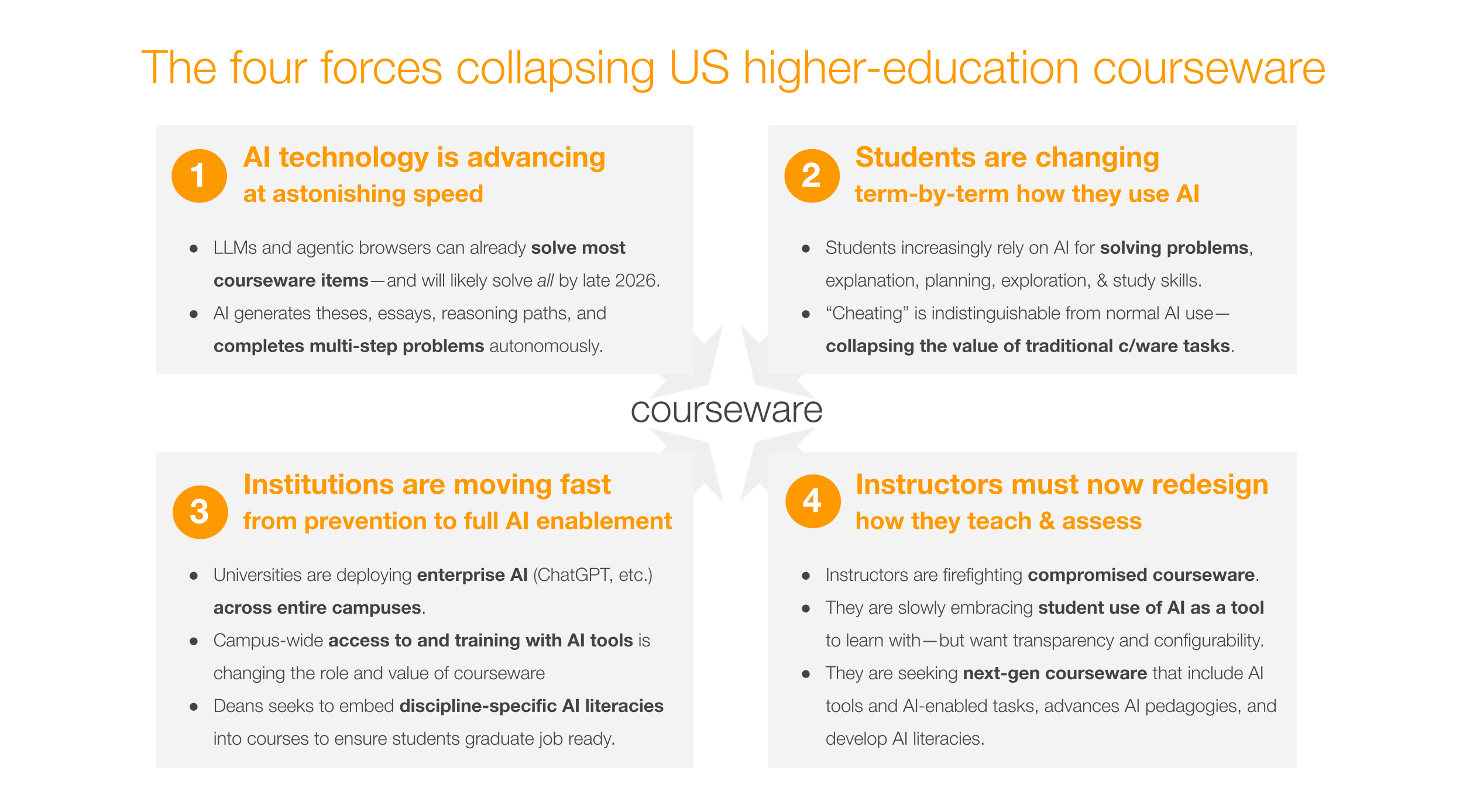
Force 1: AI technology is advancing at astonishing speed
LLMs and agentic tools can already solve most courseware tasks and will likely solve nearly all in 2026. They can generate:
- fully worked solutions
- multi-step reasoning paths
- theses, essays, and explanations
The core value propositions of traditional courseware—carefully crafted learning tasks, auto-grading, and formative insight—are being rendered obsolete by GenAI with extraordinary efficiency.
Force 2: Students are rapidly changing how they study
AI has quickly become students’ default tool for explanation, problem-solving, writing, and planning. (Earlier this year, Inside Higher Ed reported that as many as 85% of surveyed students had used GenAI for coursework in the past year.) “Cheating” and normal study behavior have effectively merged, eroding the formative functions of tasks designed for pre-AI learning and study strategies.
Force 3: Institutions are shifting from prevention to enablement
Most colleges now recognise that preventing student use of AI is the wrong goal. They are instead moving along an AI transformation pathway (see my Six-step roadmap for higher education institutions in the age of AI) by:
- deploying AI tools campus-wide to ensure equitable access
- establishing governance and transparency norms to guide responsible and productive use
- embedding discipline-specific AI literacies into core courses to ensure students graduate job-ready
These shifts accelerate both the technological and behavioral changes destabilising legacy courseware. (EDUCAUSE’s 2025 Students and Technology report similarly shows GenAI increasingly embedded into students’ everyday academic routines.)
Force 4: Instructors are being forced to reimagine teaching and assessment
Courseware tasks that once signalled understanding now signal AI proficiency. Faculty report that:
- courseware tasks no longer provide reliable evidence of learning
- grades are distorted by AI-supported work
- they are “firefighting” compromised courseware
- they need codified, effective, and safe ways to integrate AI
This leaves instructors searching for codified, practical models of AI-inclusive pedagogy—a far reach from what current courseware was designed to facilitate.
3. Why Incumbents Cannot Prevent the Collapse of US Higher Education Courseware
Today’s leading courseware (Track 1) has been “upgraded” into AI-enhanced courseware (Track 3) through bolt-on chatbots and assistants. But its underlying architecture remains built around:
- isolated auto-graded tasks
- procedural mastery and long-form writing
- assessment models now trivialised by AI
- pedagogies engineered for pre-AI instruction
This is the essence of the Innovator’s Dilemma. I believe that the leap for current courseware from Track 3 to Track 4—true AI-native courseware—is not possible as a retrofit. It is a full re-architecture of:
- the learning model
- the assessment and grading model
- the task model
- the instructor-support and insight model
- the role, configurability, and transparency of AI throughout the course
Market-leading courseware incumbents cannot readily make this pivot to an AI-native model without risking their own revenues and user bases. And, courseware designed for teaching and learning without AI cannot be retrofitted to AI-native courseware that’s fundamentally designed for teaching and learning with AI.
4. The Needs That Will Define the Next Courseware Category
As the collapse of higher education courseware proceeds, three needs are emerging that will define the next generation of solutions:
Need 1. Codified practices for AI-inclusive learning and assessment
Instructors need AI pedagogies, frameworks, templates, and guardrails—not chatbots.
Need 2. Discipline-specific AI literacies and skills
Institutions are under pressure to train students to use AI ethically, critically, and effectively, and in the context of their course and major.
Need 3. Configurable, transparent, governable AI use
Faculty need clarity on how students use AI and students need clarity on how they may use it. This requires instructor configurability of AI, transparency, and disclosure within courses.
These needs cannot be met by retrofitted courseware. They require a new category: AI-native courseware—the focus of my next blog.
Conclusion: A Structural Break—and a Strategic Opening
Those who understand the forces behind the collapse of US higher education courseware—and act early—will define the next decade.
For current market leaders, this is a pivotal moment to reassess your strategy with clear eyes.
For new entrants, it is a rare opportunity to codify emerging practices and shape the next generation of courseware.
For investors, it is the earliest point at which a new category becomes visible—and the moment to place informed bets.
If you are a market leader and want a confidential, incisive assessment of how your strategy, roadmap, and pedagogical model align with the emerging landscape, I would be delighted to help. I regularly advise CEOs, Chief Product Officers, and strategy teams navigating this transition.
If you are a market entrant and want to identify the white space, understand which learning and assessment models will differentiate you, or define the AI-native architecture required to lead this category, I can support you with market analysis, positioning, and product strategy.
If you are an investor and want to understand where value will accrue as the collapse of US higher education courseware continues, I can help you evaluate opportunities and assess strategic fit.
Make no mistake, this is the most significant inflection point in the $3B market for US higher education since digital courseware emerged 20 years ago. Those who understand the forces behind the collapse—and act early—will define the next decade.