Learning to learn again: a roadmap for higher education institutions in the age of AI

Reflections from my keynote at the Faculty × OpenAI Higher Education Summit
Last week, I had the privilege of opening the Faculty × OpenAI Summit on AI in Higher Education, held at OpenAI’s headquarters in London, and present a practical AI roadmap for higher education. The room included Vice-Chancellors, PVCs, CIOs, Deans, and senior learning leaders from across the Russell Group and peer institutions—a rare, closed-door meeting at a moment of profound disruption.
Having spent 30 years working with universities, educators, and edtechs, I have enormous respect for the ingenuity, care, and intellectual ambition of higher education. (See here for a bit more about my background.) But the sector is not insulated from the shockwaves AI is sending through every industry. And we have a collective responsibility to ensure students graduate ready for a world that is changing at extraordinary speed.
My goal in this keynote was not to add to the fear or to the hype, but to provide clarity, confidence, and a credible, actionable AI roadmap for higher education. A roadmap grounded not in theory, but in emerging best practice I’ve seen across institutions, course designs, and AI-transformed industries.
This post shares an outline of that roadmap.
The AI moment we’re in
AI adoption by students is now mainstream. 92% of UK students report using GenAI; 88% use it for assessed work. Similarly, 85% of US students are using GenAI for coursework. Lecturer confidence using AI is growing quickly too (in the UK, it has doubled in a year). Yet institutional AI policies and pedagogies remain nascent and uneven.
Meanwhile, industries from marketing and law to engineering, finance, healthcare, and consulting are rebuilding professional practices around AI tools such as Harvey, Lexis+ AI, CoCounsel, GitHub Copilot, Midjourney, and OpenEvidence. (See, for example, McKinsey’s State of AI in 2025: Agents, innovation, and transformation.)
The gap between how students learn, how industry works, and how universities teach is widening—fast. So universities face three urgent, simultaneous challenges:
- Protecting integrity and (re-)building trust—the foundations for successful learning.
- Raising AI literacy—by teaching discipline-specific AI skills.
- Modernising degrees and pedagogy—so students graduate ready for an AI-enabled workplace.
And they must do this while preserving what makes higher education so special: the human experience of inspiring teachers, collaborating with peers, and building and broadening your identity.
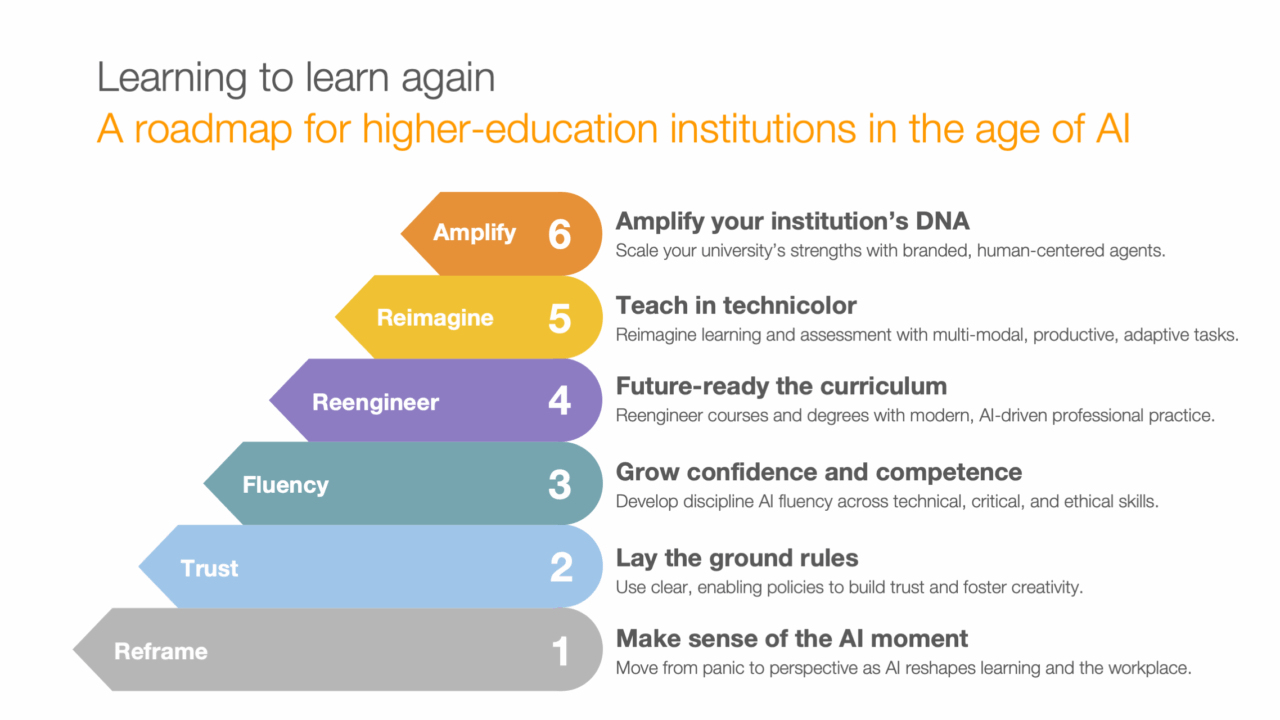
A six-phase roadmap to AI-ready universities
Here’s an outline of the AI roadmap for higher education that I presented. Each step represents real work already underway in leading institutions—not hypothetical futures, but emerging practices.
Phase 1—Make Sense of the AI Moment
Move from panic to perspective. Stop the detection arms race. Recognize that students are adapting faster than institutional policies.
Phase 2—Lay the Ground Rules
How to turn policy into trust and creativity.
Build trust through clarity: curated tools, clear rules for fair use, disclosure norms, and privacy controls. Shift governance from risk management to responsible enablement. Recognize that trust is a two-way contract—students’ use of AI for coursework, and faculty’s for teaching and assessing.
Phase 3—Grow Confidence & Competence
How to build thoughtful AI fluencies.
AI literacy is the new digital literacy. Students need technical fluency, critical evaluation, ethical judgment, and productive creative skill using AI—and employers are now explicitly hiring for these blended competencies. (There are lots of good AI literacy frameworks emerging, for example: Open University, Stanford, and Columbia.)
Phase 4—Future-Ready the Curriculum
How to re-engineer today’s degrees for tomorrow’s work.
AI is reshaping professional practice at astonishing speed. Degrees, programmes, and modules must evolve to match the AI tools and workflows graduates will encounter on day one in the workplace. Students should graduate with a portfolio of AI-enabled outputs that proves job-ready competence.
Phase 5—Teach in Technicolour
How to advance teaching, learning, and assessment with AI.
Move learning from LMS-bound to multimodal, adaptive, and accessible. Shift assessment from scoring outputs to assessing process, reasoning, and productive tasks. Atomic, AI-powered learning generates extraordinary insight—so turn every click into curriculum R&D.
Phase 6—Amplify Your Institution’s DNA
How to scale your institution’s strengths with human-centred agents.
Institution-branded AI agents—Course Assistants, University Mentors, Career Coaches, and Thrive Guides—each tuned to your university’s pedagogy, tone, and values. These same agents unlock new, flexible offerings—from accelerated/blended pathways to authentic global online degrees—without diluting your identity. (See some tips on how to build and deploy AI agents successfuly.)
Why the urgency
AI tools are advancing faster than committee cycles. Professional practices are being rewritten faster than curriculum cycles. Student behaviors and expectations are changing faster than support models. Universities that thrive in the age of AI will be those that:
- match industry speed with curricula speed
- reimagine pedagogy, not policing
- amplify faculty expertise and institutional identity
- treat AI as a chance to renew their mission
What this means for your institution or edtech business
The AI transition is rapidly reshaping higher education. The institutions that succeed will act early and intentionally. The edtech companies that become market leaders will be those that understand how AI is reshaping demand—collapsing categories and creating entirely new ones. (See my blog on which AI edtech will win in higher education and why.) If you’d like support navigating this AI transformation and translating this roadmap into practical steps for your institution, team, or product, I’d be delighted to help. Please get in touch to explore how we can shape your AI strategy, strengthen your positioning, and accelerate your progress.